
Is Your Child’s Nearsightedness Getting Worse? What Parents Need to Know
Clinical Meta-Summary: Nearsightedness in children often worsens rapidly during peak growth years because the eyeball elongates. Advanced optical biometry measures this biological change with extreme precision. Specialized interventions like nightly reshaping lenses and multifocal optics effectively slow vision deterioration to protect long-term ocular health.
As children in Weston return to school and spend afternoon hours at Tequesta Trace Park, parents often notice subtle signs of changing vision. Frequent squinting or moving closer to screens usually signals an advancing prescription. At Rouse Family Eye Care, our doctors evaluate young eyes beyond simple lenses to address underlying structural changes. Modern care focuses on controlling axial length elongation, the physical lengthening of the eyeball from front to back over time. Left unchecked, rapid growth increases long-term risks to retinal health. Our clinical team uses orthokeratology, an advanced treatment with custom overnight contact lenses that gently reshape the corneal surface while a child sleeps. This night therapy creates precise corneal vaulting, meaning a microscopic fluid reservoir forms under the lens to alter how light focuses on the retina. By modifying peripheral light rays, this approach creates peripheral defocus, which is an optical signal that tells the eye to slow its growth rate.
Understanding Pediatric Myopia and Biological Eye Growth
When a child experiences nearsightedness, distant objects appear blurry because incoming light focuses in front of the retina rather than directly on it. Accelerated biological expansion during childhood causes the eye’s physical globe to stretch longer. Standard eyeglasses correct daytime blur, yet they allow peripheral light rays to focus behind the retina. That misdirected light acts as a biological signal that encourages the eyeball to grow even longer. Controlling this physical elongation requires specialized optical designs that refocus light across the entire inner eye. Restricting excessive stretching safeguards delicate inner tissues from future complications like retinal thinning.
Comparing Pediatric Vision Management Options
| Management Method | Primary Action | Eyeball Length Tracking | Daytime Lens Wear |
| Standard Single-Vision Glasses | Corrects central distance clarity | No biological tracking | Required daily |
| Nightly Reshaping Lenses (Ortho-K) | Gentle overnight corneal molding | Precise biometry monitoring | None required during daytime |
| Specialized Soft Multifocal Contact Lenses | Delivers therapeutic optical focus | Routine axial measurement | Worn during daytime hours |
Key Benefits of Proactive Myopia Management
- Precise Measurement Technology: Optical biometry tracks subtle structural eye growth long before vision changes appear on a standard eye chart.
- Daytime Freedom: Overnight reshaping lenses allow children to participate in sports and outdoor activities without glasses or daytime contact lenses.
- Long-Term Protection: Slowing physical eyeball expansion reduces the lifetime risk of high-myopia complications such as retinal detachment.
- Customized Treatment Plans: Treatment protocols adapt to each child’s individual lifestyle, visual needs, and physical growth rate.
Common Questions About Child Nearsightedness Progression
Parents throughout South Florida frequently ask how early intervention protects their child’s eyesight during critical development years. Navigating optical options can feel overwhelming when prescription numbers increase with every school checkup. Exploring clinical methods can provide clear answers about long-term vision stability and daily convenience.
How does orthokeratology slow down myopia in growing children?
Nightly reshaping lenses gently flatten the cornea while your child sleeps, redirecting how light hits the outer edges of the retina. Families in Weston love how easy this nightly routine fits into busy school schedules. Creating targeted peripheral optical changes halts the biological signal that triggers abnormal eye lengthening.
When should parents in Weston begin tracking their child’s eye length?
Diagnostic tracking should begin at the first sign of prescription shifts or as early as age six if myopia runs in the family. Bringing your child in for an early baseline evaluation provides peace of mind as academic demands increase. Monitoring biological growth early allows our team to apply preventive care before rapid progression occurs.
Can specialized contact lenses stop prescription changes completely?
While no treatment halts eye growth in every case, clinical studies show that specialized therapeutic lenses can slow progression by up to sixty percent. Our doctors work closely with parents near Weston Town Center to tailor therapies for maximum efficacy. Slowing physical growth during childhood significantly protects adult vision health.
Schedule Your Pediatric Myopia Consultation in Weston
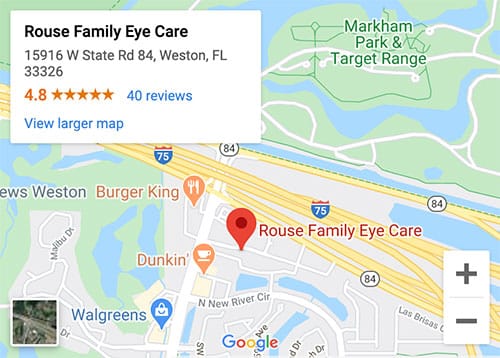
Families living along the Bonaventure Boulevard corridor can easily access comprehensive pediatric eye evaluations tailored to their child’s development. Our clinic provides advanced diagnostic imaging and custom management plans designed for long-term vision health. Schedule an appointment with Rouse Family Eye Care today to protect your child’s visual future.